
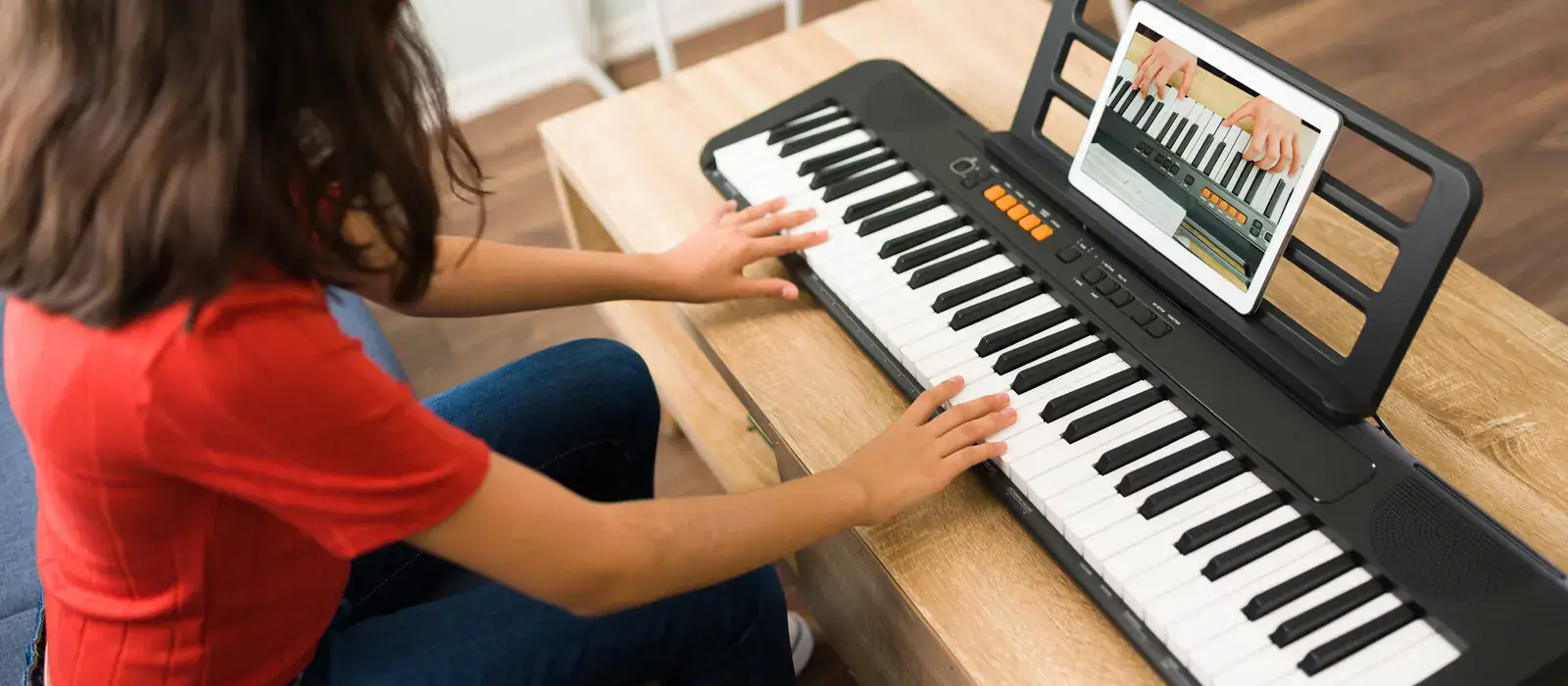
In-home, studio, or online — choosing the music lesson format that fits your family in Nairobi
Three formats, three different trade-offs. We teach all three — here's an honest comparison of how they work, who they suit, and where each one quietly fails.
 Concerto Team
- # lessons
- # in-home
- # online
- # studio
- # nairobi
Every family that contacts us about lessons is choosing between three formats, even if they don't realise it. Studio (you come to us in Kikuyu), in-home (a trainer comes to you), or online (live one-on-one over video). We teach all three, and we have genuine preferences about which works for which families — preferences we'll share even when they're not the most profitable for us. This guide is the long version of that conversation.
Studio lessons — the default for a reason
Our studio at ACK Immanuel Church, Kikuyu is where most of our students learn. There are good reasons it's the default format at most serious music schools globally:
- The instrument is right there. Acoustic pianos, real drum kits, full string setups, room for movement and posture work — none of which fit in most homes.
- The trainer's full attention. No phone interruptions, no younger sibling running through, no doorbell. The 45 minutes are yours.
- Community. Students see other students between lessons. The hallway conversations matter more than parents realise — it's where motivation lives.
- Exam preparation context. When exam sitting approaches, students are already comfortable in the room they'll sit the exam in.
The cost: getting there. For families in Kikuyu, Karen, Langata, Limuru and the surrounding Kiambu satellites it's a 10–30 minute drive — very workable for a weekly commitment. For families further out (Westlands, Kileleshwa, Karen on a weekday) it's a real trade-off against traffic. See our Kikuyu hub page for studio details, or browse by town for distance estimates.
In-home lessons — what they actually deliver
An in-home lesson is a trainer arriving at your house at the same time every week. We send the same trainer each visit, with an ID card, on a schedule we hold for you for the full term. The premium over studio pricing reflects what makes it worth choosing: continuity, convenience, and a learning environment that fits your child's actual life.
Where in-home shines:
- Multiple children. Two or three siblings learning back-to-back at the same address is dramatically more efficient than three studio commutes.
- Tight schedules. Lessons can slot into a window that wouldn't survive a Nairobi drive — Wednesday 4:30 p.m. between school pickup and homework, for example.
- Young children. A four-year-old's attention span doesn't survive a 35-minute drive to a lesson. At home, the lesson starts when they're ready.
- Instrument is already at home. A child's own piano, own keyboard — the practice surface and lesson surface are identical.
Where in-home quietly fails: when the home isn't structurally a lesson space. A trainer cannot teach a focused 45-minute lesson if a younger sibling is running through, the TV is on next door, or the household help is vacuuming. Parents who choose in-home need to commit to making the room a lesson room for those 45 minutes. Read more about how in-home works, or request a consultation if you're considering it.
Online lessons — better than parents expect
Live online lessons over Zoom or Google Meet were a pandemic adaptation that turned out to be permanent. They are not a downgrade — for some students they are clearly the right format. We teach a meaningful share of our roster fully online, including most of our international students and several families in counties we don't physically serve.
Where online wins:
- Geography. If you're not in Nairobi or Kiambu, online is the only practical way to study with our faculty. We teach students in Mombasa, Kisumu, Eldoret, Nakuru and across the diaspora.
- Schedule flexibility. 6:30 a.m. lessons before school, 9 p.m. lessons after a parent's workday — both genuinely possible online, neither practical for studio.
- Older students. Teenagers and adult learners who don't need the in-person social motivation often prefer online for the time it gives back.
Where online struggles: very young children (under 8), pure beginners in their first 3 months on an instrument, and any student whose home internet isn't reliable enough for stable video. We're honest about this in the first conversation — if a family asks about online for a six-year-old beginner, we typically suggest at least 6 months of in-home or studio first. Learn more about our online lesson programme.
How to decide
Three questions, in order:
- How old is the student? Under 8, lean toward studio or in-home. 8–12, all three work. Teenager or adult, all three work, online often wins on time.
- Where do you live? Within 20 minutes of Kikuyu, studio is sensible. 20–45 minutes, the maths depends on traffic and whether you have multiple children. Beyond 45 minutes, in-home or online.
- What's the long-term goal? If you're aiming at the ABRSM exam ladder seriously, studio gives you the strongest preparation. If lessons are recreational, all three formats produce good results.
A year of lessons — what each format actually costs
Setting aside the per-session rate, here's roughly what each format costs across 40 weeks of lessons (a typical Kenyan school year, accounting for term breaks):
- Studio: 40 sessions × KES 1,800 = KES 72,000. Add fuel and time for the weekly drive — for a Nairobi family doing 25 km round-trip at KES 200 per visit, that's another KES 8,000 in fuel plus the time cost. All-in around KES 80,000–85,000.
- In-home: 40 sessions × KES 2,500 = KES 100,000. No fuel, no time cost. Net all-in around KES 100,000.
- Online: 40 sessions × KES 2,500 = KES 100,000. No fuel, no traffic, scheduling flex worth real money for working parents. The hidden cost is decent internet and a working camera setup — most families already have both.
For families considering between studio and in-home, the cost gap (~KES 15,000–20,000 a year) usually disappears once you account for fuel, parking, and the time-value of the weekly commute. In-home is the more expensive headline rate, but the all-in numbers are closer than they look.
Safeguarding when a trainer comes to your home
The honest conversation parents should have before committing to in-home lessons. The trainer is in your house, often with your child unsupervised for 45 minutes. Three things any reputable school should provide as a matter of course:
- Trainer ID card with photo and current contact for the school. Our trainers carry these; you should ask to see one at the first visit.
- Background-checked, safeguarding-trained faculty. Reputable schools run background checks before hiring and provide safeguarding training to all teaching staff. We do; many smaller Nairobi operators do not. Ask directly.
- An open-door policy. The teaching room door stays open during the lesson, or there's a parent in another room with line-of-sight or audio range. This protects the trainer as much as the child.
If a school cannot answer these questions clearly, the school is the wrong school. The conversation isn't impolite — it's professional, and faculty members who care about safeguarding will appreciate being asked.
The hybrid that often works best
A pattern we increasingly recommend: studio lessons during school terms (when the family routine supports the drive), online during exam season (when consolidation matters more than the social context), and in-home for very young children until they're old enough for the studio commute. The format can change. Many of our longest-running students have studied with us in two or three formats over the years.
How students move between formats over the years
The format a student starts in is rarely the format they end in. Looking back across our long-term roster, the most common five-year trajectories:
- In-home → Studio. Roughly 40% of students who start in-home transition to the studio by age 9 or 10. The trigger is usually the child's growing independence and the household feeling that the drive has become workable. Many parents tell us the drive itself becomes a routine — Saturday morning lesson, lunch in Kikuyu, errands, home. The thing that felt impossible at age 6 is unremarkable at age 10.
- Studio → Online (for upper grades). Around 30% of students grade 5 and above shift partly or fully online in their final years with us. By that point the social motivation of the studio matters less, the technical work is mostly between the student and the trainer, and the time-savings of online become meaningful as homework loads grow. We've taken students from Grade 4 to Grade 8 entirely online without losing pace.
- Studio + Online hybrid for exam preparation. Roughly half of our exam-bound students switch to a mixed pattern in the eight weeks before a sitting — extra online sessions for technical work between the regular weekly studio lesson. The format hybrid is a tool for the exam cycle, not a permanent change.
- In-home throughout. About 15% of students who start in-home never transition. Usually families with multiple children or households where the in-home routine works so well there's no reason to change. Both groups produce excellent musicians — there's no penalty in our experience for staying in-home indefinitely if it fits the family.
What this means for the choice you're making now: the first format doesn't have to be the right format forever. It has to be the right format for the next 18 months. Start there, see how the household and the child respond, and let the future format question answer itself when the time comes.
If you're not sure which fits your household, talk to us. The first lesson is a free discovery session precisely so this is a low-stakes decision — book it in whichever format you're most curious about, and we'll be honest in the follow-up about whether you've chosen well or whether another format would suit better.
Share this piece
WhatsAppContinue reading
More from Guides.
Guides
How to choose your child's first instrument — a Kenyan parent's guide
Piano, keyboard, guitar, violin or voice — the first instrument shapes years of practice habits. Here's how Kenyan parents we work with actually decide, and what we wish more of them knew before they bought anything.
Concerto Team · 9 min read
Guides
Ready for your ABRSM exam? How we check before you pay to sit it
ABRSM entry fees aren't small, and they climb with every grade. So before any Concerto student books an exam, we run an honest readiness check — a full mock under real conditions. If you're not ready, we say so. Here's exactly how we decide.
Concerto Team · 5 min read
Guides
Piano vs Keyboard for beginners — what to buy in Nairobi, and why it matters
They look similar, cost very different things, and produce wildly different learners. A practical guide to choosing — and what we actually tell parents who walk into our Kikuyu studio with this question.
Concerto Team · 8 min read
Ready to try a lesson?
Free discovery session at our Kikuyu studio, in-home across Nairobi, or live online. We'll be honest about whether we're the right fit.