
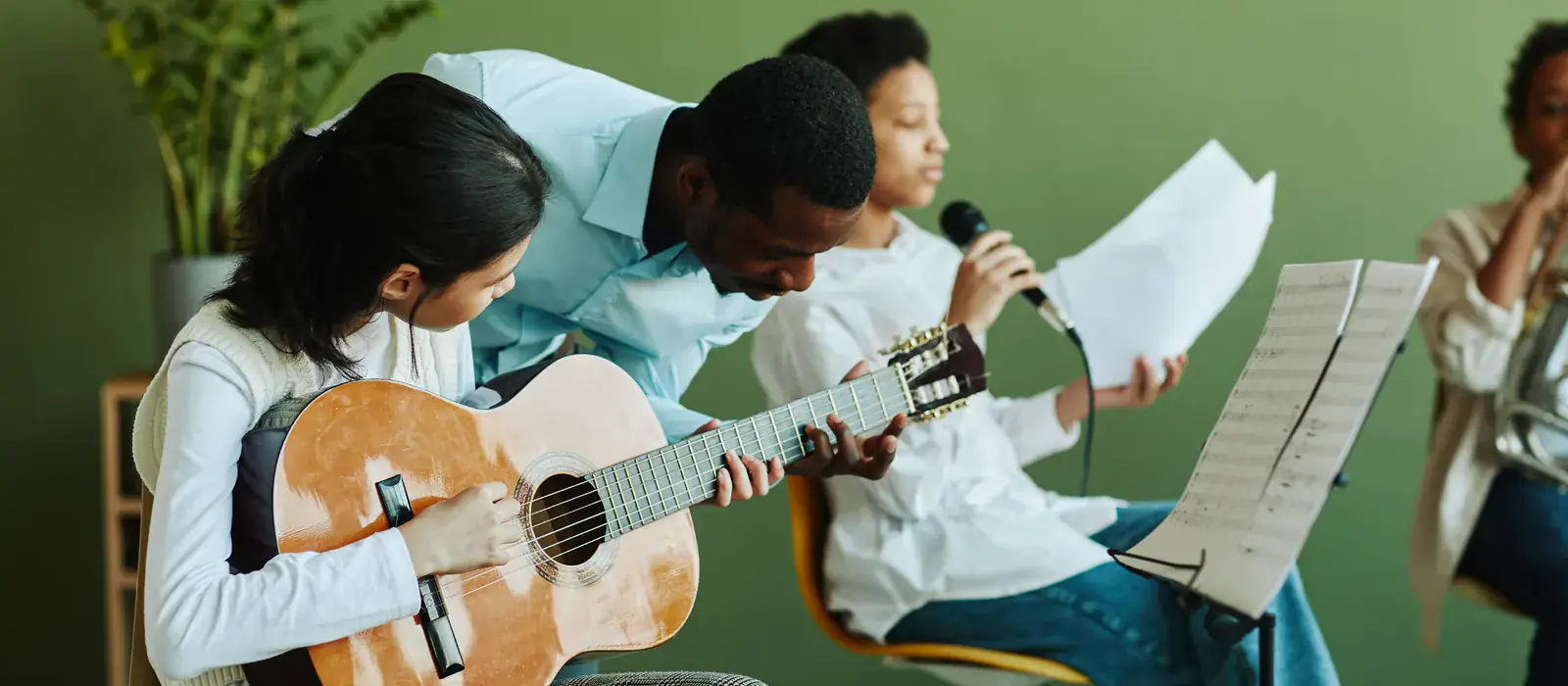
Why 30 minutes a day beats 3 hours on Saturday
Every term we have the same conversation with at least one family: the child practises three hours on Saturday and twenty minutes the rest of the week. Here's why we always recommend the opposite, and the small change that usually fixes it.
 Concerto Team
- # practice
- # learning-tips
- # parents
The conversation comes up every term. A parent corners us after a lesson, frustrated. "He practises for three hours on Saturday morning. Why isn't he progressing faster?" The honest answer is that three hours on Saturday is less useful than 30 minutes a day, and it's not even close. Here's why, and what to do about it.
What the brain does between practices
Learning an instrument is, structurally, a motor-skill problem. Your fingers are being trained to do something they couldn't do before. And the research on motor-skill acquisition is unusually clear: the consolidation of the skill happens between practice sessions, during sleep, not during the practice itself.
This is why a violinist who works on a difficult passage on Tuesday often comes back on Wednesday and finds it suddenly easier. Their brain has been rehearsing the passage offline — pruning the neural pathways, locking in the muscle memory, getting rid of the false starts. Sleep doesn't just rest the body; for skill learning, it does the actual work.
This has a practical consequence. Practice followed by sleep is many times more effective than practice with no sleep before the next session. Six 30-minute sessions across a week, each followed by a night's sleep, produce dramatically more learning than one three-hour session followed by six days of nothing.
The three-hour Saturday illusion
The reason families fall into the Saturday-marathon pattern is that it feels like real work. Three hours is a lot of time. The instrument case is open, the music is out, the child is at the piano. The parent walks past and sees commitment.
What's actually happening, in our experience watching students: the first 25 minutes are productive. The next 30 are fading. By minute 70, the student is making more mistakes than they're correcting — and worse, they're now practising the mistakes, which means they're getting better at playing wrong notes. By minute 110, the student is exhausted, frustrated, and developing a quiet aversion to the instrument that will compound over the next six days of avoidance.
The next Saturday, the same pattern. Net result: lots of time, slow progress, and a child who increasingly dreads music practice.
The change that fixes it
Six 25-minute sessions a week. That's the recommendation. Not 30 minutes, not 45 — 25, because that's roughly how long a young brain can hold focused attention on technical music practice before quality degrades. After 25 minutes, stop, do something else, come back the next day.
For most families, the implementation question is when. We recommend tying practice to an existing daily routine — before breakfast, immediately after school, before a screen-time slot. The specific time matters less than the consistency. The brain is a creature of pattern, and "I practise at 4 p.m." is, after a few weeks, almost automatic. "I practise when I have time" is almost never.
The Saturday lie-in is still allowed
Six sessions a week leaves one day off. Make it the day your family least naturally has time for music — usually Sunday, often Saturday for families with weekend activities. The off day is part of the plan, not a failure. Brains need recovery, the household needs a break, and the streak-style "I missed a day, the whole plan is broken" psychology of perfectionist routines is genuinely counterproductive. Six out of seven is the goal. Five out of seven is fine. Three out of seven is when we have a conversation.
For parents whose child resists
If daily practice is currently a battle, two suggestions before the battle becomes the relationship. First, drop the duration before you negotiate the frequency — 10 minutes a day, every day, for two weeks, is more useful than the argument over 30 minutes. Win the consistency first, then expand it.
Second, find one piece they love. Not the exam piece, not the technical exercise — a piece they chose. Practice sessions that start with three minutes of "the fun piece" before moving into the work tend to have less resistance than ones that start cold. Our trainers will happily nominate a piece in the right grade range; ask.
The instrument is meant to be a source of pleasure, eventually if not immediately. Three hours on Saturday turns it into a chore. Thirty minutes a day, for years, turns it into a habit — and habits, in music, are the entire game. Book your child's next lesson, then come back on Monday with the practice plan.
Share this piece
WhatsAppContinue reading
More from Learning Tips.
Learning Tips
What we learned teaching through exam season 2025
Forty-three of our students sat ABRSM grade exams across the November 2025 and March 2026 sittings. Here's what worked, what didn't, and the three small changes we're making to our exam preparation routine for the next cohort.
Concerto Team · 5 min read
Guides
How to choose your child's first instrument — a Kenyan parent's guide
Piano, keyboard, guitar, violin or voice — the first instrument shapes years of practice habits. Here's how Kenyan parents we work with actually decide, and what we wish more of them knew before they bought anything.
Concerto Team · 9 min read
Guides
Ready for your ABRSM exam? How we check before you pay to sit it
ABRSM entry fees aren't small, and they climb with every grade. So before any Concerto student books an exam, we run an honest readiness check — a full mock under real conditions. If you're not ready, we say so. Here's exactly how we decide.
Concerto Team · 5 min read
Ready to try a lesson?
Free discovery session at our Kikuyu studio, in-home across Nairobi, or live online. We'll be honest about whether we're the right fit.