
01
Studio.
Come to our Kikuyu studio. Private or small-group sessions, in the room with your trainer and a proper instrument.
KES 1,600/ session
Book a studio classKeyboard lessons
Portable, affordable, and at home in every genre you actually listen to — gospel, afro-pop, contemporary worship, hip-hop, jazz. Our keyboard programme follows the ABRSM Keyboard syllabus and gets you band-ready faster than a traditional piano track.
Accreditation
ABRSM Keyboard syllabus
Grade range
Initial – Grade 5 (bridges to Piano 6–8)
Focus
Worship · Contemporary · Pop · MIDI
First lesson
Free discovery session
The journey
Beginner to Grade 5 (ABRSM Keyboard) — bridges to Piano Grades 6–8. Each milestone below is roughly a year of consistent practice; ABRSM certification is recognised worldwide and counts toward UCAS points for university applications.
01
Foundation (Pre-Initial).
Posture, hand position on a 61-key board, the first six chords (C, G, F, Am, Dm, Em), simple right-hand melodies, drum-pattern selection on your keyboard, and how to play one full song with backing rhythm by lesson four.
Outcome:Ready to sit ABRSM Keyboard Initial.
02
Initial – Grade 1.
Auto-accompaniment styles, syllabus pieces across pop and classical, simple sight-reading, basic registration changes (swapping between piano, organ, strings sounds mid-song), and your first solo performance for parents at the end-of-term recital.
Outcome:ABRSM Keyboard Grade 1 — confident across two voices and three styles.
03
Grade 2 – 3.
Two-hand coordination with intricate accompaniment, modulation between sections, intentional voice and style choices for the song, and reading lead-sheet notation (the standard for worship bands).
Outcome:ABRSM Keyboard Grade 3 — band-ready for church and youth groups.
04
Grade 4 – 5.
Advanced repertoire across pop, jazz and gospel, MIDI programming, layering and splitting sounds, recording your performances, and Theory Grade 5 (the ABRSM gateway for higher practical grades).
Outcome:ABRSM Keyboard Grade 5 — eligible for Piano Grades 6–8 progression.
05
Piano-track progression (Grade 6+).
ABRSM Keyboard tops out at Grade 5; students who want to progress beyond this transfer to our Piano track (Grades 6–8 and Diploma) with the technique they've built carrying straight over. No need to start again.
Outcome:Performance-grade or Diploma certification via the Piano syllabus.
How you can learn
01
Come to our Kikuyu studio. Private or small-group sessions, in the room with your trainer and a proper instrument.
KES 1,600/ session
Book a studio class02
Trainer comes to you — Muthaiga, Kileleshwa, Kilimani, Upperhill, Milimani. Same faculty, your space, no commute.
Premium · pricing on enquiry
How in-home works03
Live one-on-one over our private classroom. Anywhere with a stable connection — Kenya or abroad.
KES 2,000/ session
Try onlineInside the room
Every session has a rhythm. Here's the shape of a typical hour — adjusted up or down depending on age, grade and what your last week looked like.
00:00 – 00:05
Warm-up.
Five-finger exercise across two octaves with the auto-rhythm on at 80 bpm. Switch hands halfway through.
00:05 – 00:15
Voice & style drill.
Pick a song you know. Play it through three times — once with a piano voice and pop style, once with strings and ballad style, once with organ and gospel style. The point is hearing how voice choice changes the song.
00:15 – 00:35
Repertoire.
One ABRSM piece or one song from your weekly list — phrasing, dynamics, registration changes between sections, getting the auto-accompaniment to follow your tempo.
00:35 – 00:50
Lead-sheet reading.
A fresh chord chart from a contemporary worship or pop song. Read it cold, then play it through twice.
00:50 – 01:00
Practice plan.
Daily targets written in the student journal. Parents of younger students get a copy by email.
The faculty
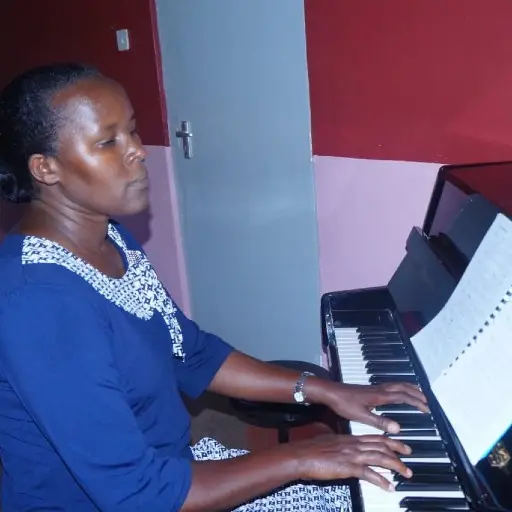
Trainer
piano · vocals · flute · saxophone · recorder · theory · wind · guitar · violin
Available today
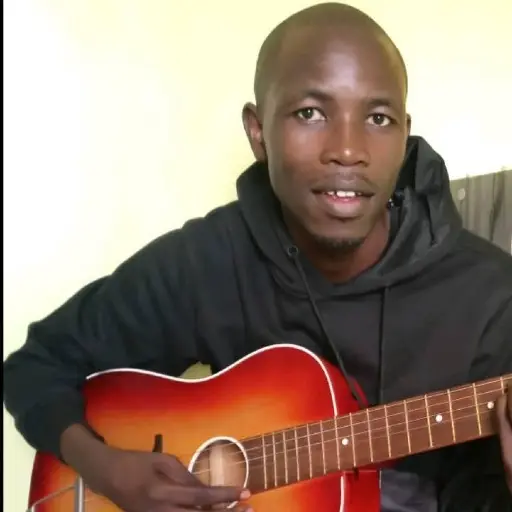
Trainer
guitar · piano · vocals
Available today

Trainer
piano · recorder · theory · guitar

Trainer
piano · guitar
Frequently asked
For young beginners (5–10) without an acoustic piano at home, keyboard is the practical choice — portable, weighted enough to build technique, and the auto-accompaniment makes early practice genuinely fun. We can transfer your child to the piano track from Grade 3 onward with no loss of progress.
Look for at least 61 keys (76 is better), velocity-sensitive (touch-response), with built-in speakers and onboard rhythms/voices. Yamaha PSR-E series and Casio CT-S series are reliable in the KES 18,000–35,000 range. Avoid 49-key toy keyboards — they cap your progression at about three months.
Absolutely — that is one of our most common student paths. Our worship-focused track adds chord-chart reading, pad work, key-modulation between songs, and ensemble rehearsal etiquette. Several of our advanced students play weekly at churches across Kiambu and Nairobi.
Same fundamentals (note-reading, scales, technique), different repertoire bias. Piano leans classical and exam-driven; keyboard leans contemporary, worship and band-readiness. Both are valid and we are honest about which suits your goal.
Yes — from Grade 3 we introduce MIDI controllers, basic DAW workflow (we teach in Reaper and GarageBand for cost reasons), and how to record your own backing tracks. Bigger studio production is its own course.
Yes, and adults often progress faster than children because they bring focus and clear goals. Our adult beginner cohort meets in the evenings and on Saturdays; most reach Grade 2 standard within a year.
Yes — we use a low-latency private classroom with a dual-camera setup so your trainer sees both hands and your face. International students join from across East Africa and beyond.
Yes — families enrolling two or more children receive a multi-child discount automatically applied to the second child onward. Speak to our admin for current rates.
Book your first lesson — your trainer will meet you wherever you are, with a plan tailored to your goals.