01
Studio.
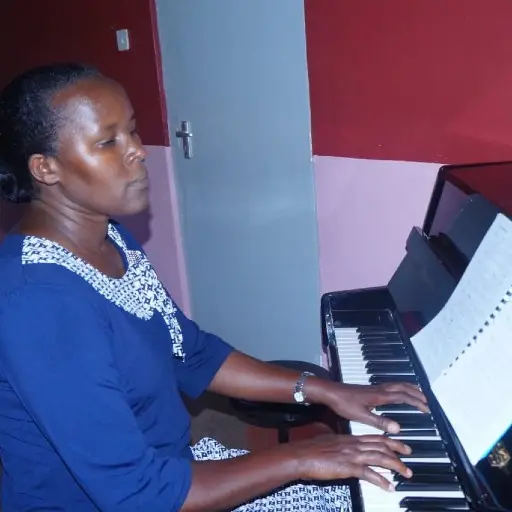
Come to our Kikuyu studio. Private or small-group sessions, in the room with your trainer and a proper instrument.
KES 1,600/ session
Book a studio classViolin lessons
The violin rewards patience more than any other instrument — and pays it back with the most expressive voice in the orchestra. Our strings programme follows the ABRSM Violin syllabus, with Suzuki method foundations for younger learners. Viola and cello available under the same faculty.
Accreditation
ABRSM Violin
Grade range
Initial – Grade 8
Methods
Suzuki · Traditional · Suzuki-Traditional hybrid
Sibling instruments
Viola · Cello
The journey
Beginner to Grade 8 (ABRSM). Each milestone below is roughly a year of consistent practice; ABRSM certification is recognised worldwide and counts toward UCAS points for university applications.
01
Foundation (Pre-Grade 1).
How to hold the violin and bow without tension, how to tune, basic open-string bowing, first finger placements with tape markers, simple folk melodies and Twinkle Variations (the Suzuki gateway). 3/4 and 1/2 size instruments for young learners.
Outcome:Ready to sit ABRSM Initial or Grade 1.
02
Grade 1 – 2.
Full first position across all four strings, simple scales (D major, G major, A minor), basic vibrato introduction, dotted rhythms, three short repertoire pieces. Group ensemble play with other Grade 1–2 strings students.
Outcome:ABRSM Grade 2 — first-position confident, ensemble-ready.
03
Grade 3 – 4.
Second and third positions, shifting, full vibrato, double-stops, expressive bowing techniques (legato, staccato, spiccato), and listening tests sharpening aural recognition.
Outcome:ABRSM Grade 4 — performance-ready solo and in ensemble.
04
Grade 5 – 6.
Theory Grade 5 (the ABRSM gateway), advanced positions (up to seventh), three-octave scales, sonata and concerto movements, sight-reading at tempo. Recital programme begins.
Outcome:Theory Grade 5 passed — unlocks higher practical grades.
05
Grade 7 – 8.
Performance-level interpretation, ricochet and sautillé bowing, advanced double-stops, concerto cadenzas, recital preparation. Programme one solo performance per term at our end-of-year recital.
Outcome:ABRSM Grade 8 — recognised diploma-entry credential worldwide.
06
Diploma & beyond.
ARSM, DipABRSM and LRSM preparation. For those targeting orchestral seat positions, teaching careers or undergraduate music study.
Outcome:Diploma certification — eligible to teach violin professionally.
How you can learn
01
Come to our Kikuyu studio. Private or small-group sessions, in the room with your trainer and a proper instrument.
KES 1,600/ session
Book a studio class02
Trainer comes to you — Muthaiga, Kileleshwa, Kilimani, Upperhill, Milimani. Same faculty, your space, no commute.
Premium · pricing on enquiry
How in-home works03
Live one-on-one over our private classroom. Anywhere with a stable connection — Kenya or abroad.
KES 2,000/ session
Try onlineInside the room
Every session has a rhythm. Here's the shape of a typical hour — adjusted up or down depending on age, grade and what your last week looked like.
00:00 – 00:05
Tuning & posture.
Tune all four strings together with the trainer. Posture check — shoulder, neck, bow grip. Two open-string warm-ups.
00:05 – 00:15
Technique focus.
Scale of the week (currently A major, three octaves), then a shifting exercise from first to third position. Vibrato drill on long notes.
00:15 – 00:35
Repertoire.
One ABRSM piece in detail — bow distribution, phrasing, intonation in the trickier passages worked slowly then up to tempo.
00:35 – 00:50
Sight-reading & aural.
A fresh short piece read cold, then short aural tests — pitch recognition, simple cadence identification.
00:50 – 01:00
Practice plan.
Daily targets written in the student journal. Parents of younger students get a copy by email.
The faculty
Frequently asked
We accept students from age four upward, using 1/16 to 1/2 size violins as appropriate. Younger learners (4–6) begin with Suzuki-method foundations focusing on listening, posture and bow-hand coordination before formal note-reading. Note-reading typically begins around age 6–7.
Sizes range from 1/16 (tiny — ages 3–5) up through 1/8, 1/4, 1/2, 3/4 and full size (4/4). The right size depends on arm length, not age. We measure students at their first lesson and recommend the right size — most local music shops in Nairobi rent fractional violins affordably.
Yes — particularly for younger learners. Several of our string trainers are Suzuki-trained. For older students and adults we use a hybrid approach (Suzuki listening + ear training combined with traditional sight-reading) that builds both intuitive musicality and reading fluency.
Yes. Beyond classical repertoire, we teach Irish, Bluegrass and East African folk styles. The technique overlaps significantly with classical, so even fiddle-focused students benefit from the classical foundations of bow control and intonation.
Yes. Our strings faculty teach all three. Viola uses the alto clef rather than treble (a small adjustment for violin-trained players), and cello sits between the legs with a longer bow — different physical setup but the same musical principles.
Yes — our strings ensemble meets weekly, and intermediate-and-above students from Grade 3 upward are encouraged to join. Group ensemble play is the fastest way to develop intonation in context and to discover whether you want to pursue chamber or orchestral music.
Yes — we use a dual-camera setup over a low-latency classroom. Tuning together is the one weak point of remote lessons (we will recommend a clip-on tuner), but every other aspect translates well.
Honestly: violin is hard at the start. The first three months of squawky open-string bowing test parental patience. By month six most students play recognisable tunes; by year one (with consistent daily practice) they are at Grade 1 standard. The plateau breaks around month nine — push through it.
Book your first lesson — your trainer will meet you wherever you are, with a plan tailored to your goals.