01
Studio.
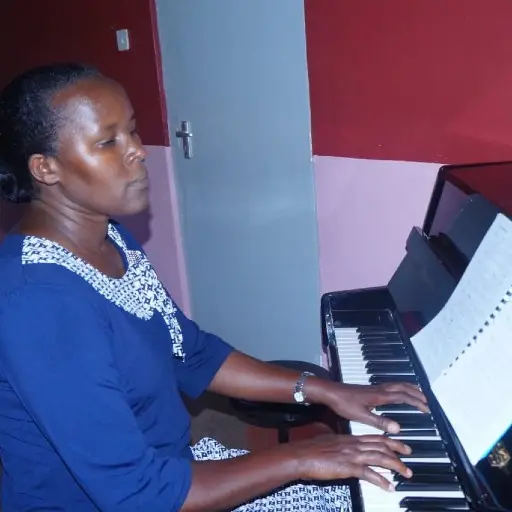
Come to our Kikuyu studio. Private or small-group sessions, in the room with your trainer and a proper instrument.
KES 1,600/ session
Book a studio classVoice lessons
From shy-in-the-shower beginners to working performers, our voice programme builds range, control and the confidence to fill any room. ABRSM Singing syllabus, contemporary and worship repertoire, and ensemble preparation under one faculty.
Accreditation
ABRSM Singing
Grade range
Initial – Grade 8 + Diploma
Repertoire
Classical · Contemporary · Worship · Choral
Companion
Choir & ensemble at /vocal-training
The journey
Beginner to Grade 8 (ABRSM Singing). Each milestone below is roughly a year of consistent practice; ABRSM certification is recognised worldwide and counts toward UCAS points for university applications.
01
Foundation (Pre-Grade 1).
Breath support, posture, vocal warm-ups, basic range exploration, simple folk and contemporary repertoire, learning how to listen to yourself accurately. By the end you sing one full song with intentional dynamics.
Outcome:Ready to sit ABRSM Singing Initial or Grade 1.
02
Grade 1 – 2.
Diaphragmatic breathing under load, vowel placement, sustained phrases, simple two-part harmony with the trainer, pitch accuracy across a single octave, three syllabus pieces.
Outcome:ABRSM Singing Grade 2 — confident across one comfortable octave.
03
Grade 3 – 4.
Extended range (typically 1.5 octaves), basic riffs and runs (contemporary track), bel canto fundamentals (classical track), ensemble blend skills, listening tests, three repertoire pieces.
Outcome:ABRSM Grade 4 — solo recital-ready and ensemble-ready.
04
Grade 5 – 6.
Theory Grade 5 (the ABRSM gateway), two-octave range work, art-song interpretation, contemporary belting (when appropriate), languages (Italian for classical, Swahili for African vocal repertoire), sight-singing.
Outcome:Theory Grade 5 passed — unlocks higher practical grades.
05
Grade 7 – 8.
Performance-level interpretation, languages (German, French, Latin), advanced ornamentation, recital programming, healthy vocal stamina under performance pressure.
Outcome:ABRSM Grade 8 — recognised diploma-entry credential worldwide.
06
Diploma & beyond.
ARSM, DipABRSM and LRSM preparation — recital repertoire, programme notes, performance practice. For those targeting professional performance, choir direction, teaching or undergraduate music study.
Outcome:Diploma certification — eligible to teach voice professionally.
How you can learn
01
Come to our Kikuyu studio. Private or small-group sessions, in the room with your trainer and a proper instrument.
KES 1,600/ session
Book a studio class02
Trainer comes to you — Muthaiga, Kileleshwa, Kilimani, Upperhill, Milimani. Same faculty, your space, no commute.
Premium · pricing on enquiry
How in-home works03
Live one-on-one over our private classroom. Anywhere with a stable connection — Kenya or abroad.
KES 2,000/ session
Try onlineInside the room
Every session has a rhythm. Here's the shape of a typical hour — adjusted up or down depending on age, grade and what your last week looked like.
00:00 – 00:10
Warm-up.
Breath drills, lip trills, sirens, then five-note scales ascending and descending through your comfortable range. Hydrate.
00:10 – 00:20
Technique focus.
One isolated drill — vowel placement, range extension, breath under sustain. The same drill for two weeks until it becomes automatic.
00:20 – 00:40
Repertoire.
One song or art-song in detail. Trainer plays accompaniment. We work phrasing, dynamics, breath plan, and the trickier intervals slowly before performance tempo.
00:40 – 00:50
Aural & ear training.
Interval recognition, simple sight-singing, cadence identification — the skills examiners test directly.
00:50 – 01:00
Practice plan.
Daily targets: 10 minutes warm-ups, 15 minutes technique, 15 minutes repertoire. Never over-sing — quality over quantity.
The faculty
Frequently asked
We accept students from age six upward. Younger learners benefit more from group singing (rhythm clapping, listening games, group songs) which we run in our junior choir track — formal one-to-one technique work waits until age six or seven, when vocal cords are mature enough.
Almost certainly. True tone-deafness (amusia) is rare — about 1 in 50 people. The much more common issue is untrained ear-pitch coordination, which is teachable. Within three months of weekly lessons most "I can't sing" adults are reliably hitting pitch within their natural range.
We assess this in your first lesson. Roughly: women are sopranos (high), mezzos (middle) or altos (low); men are tenors (high), baritones (middle) or basses (low). Your fach guides repertoire choice but does not limit you — most pop and worship music sits in a flexible mid-range usable by any voice.
Both. Several of our faculty came up through contemporary music (gospel, R&B, musical theatre); others are classically trained. We match you with the trainer whose technique fits your goal — and we will teach you healthy belting, not the throat-shredding kind.
Yes — that is one of our most common student paths. Audition prep adds sight-reading drills, blend exercises, audition-piece selection, and mock auditions. See /vocal-training for our choir-focused programme.
Yes — and voice translates particularly well to online lessons since the trainer mainly needs to hear you, not see complex finger work. We use a low-latency private classroom; many of our international students train this way.
Hydrate (room-temperature water, not iced), warm up before any sustained singing, sleep enough, avoid yelling and whispering (both more damaging than normal singing), and back off entirely when you feel a sore throat coming on. We teach vocal-health fundamentals in every lesson.
Yes — see our /vocal-training page for choir, ensemble and workshop offerings. Many voice-lesson students join a choir as a complement to their solo work; the combination develops you fastest.
Also explore
Book your first lesson — your trainer will meet you wherever you are, with a plan tailored to your goals.