
Piano vs Keyboard for beginners — what to buy in Nairobi, and why it matters
They look similar, cost very different things, and produce wildly different learners. A practical guide to choosing — and what we actually tell parents who walk into our Kikuyu studio with this question.
 Concerto Team
- # piano
- # keyboard
- # beginners
- # buying-guide
- # nairobi
"Should we just get a keyboard? They're cheaper." It is the single most common follow-up question we hear after a discovery lesson, and the honest answer is more interesting than yes or no. This guide walks through what actually separates a keyboard from a piano — what your child or you will feel under the fingers, how it shapes the next two years of learning, and which choice we recommend depending on where you are in the journey.
The three categories, not two
Most parents come in thinking it's a binary: piano or keyboard. There are really three options:
- Keyboard: Light, unweighted keys. Built-in sounds (organ, strings, drums). Battery or mains. KES 15,000–35,000.
- Digital piano: Weighted keys that simulate an acoustic. Usually piano-only, sometimes with a few extra sounds. KES 45,000–150,000.
- Acoustic piano: Strings, hammers, soundboard. Needs tuning twice a year. KES 120,000+ for a used upright, much more new.
The decision parents think they're making is "piano vs keyboard." The decision they're actually making is "do I want my child practising on weighted keys?" Get that right and the rest follows.
Why weighted keys matter
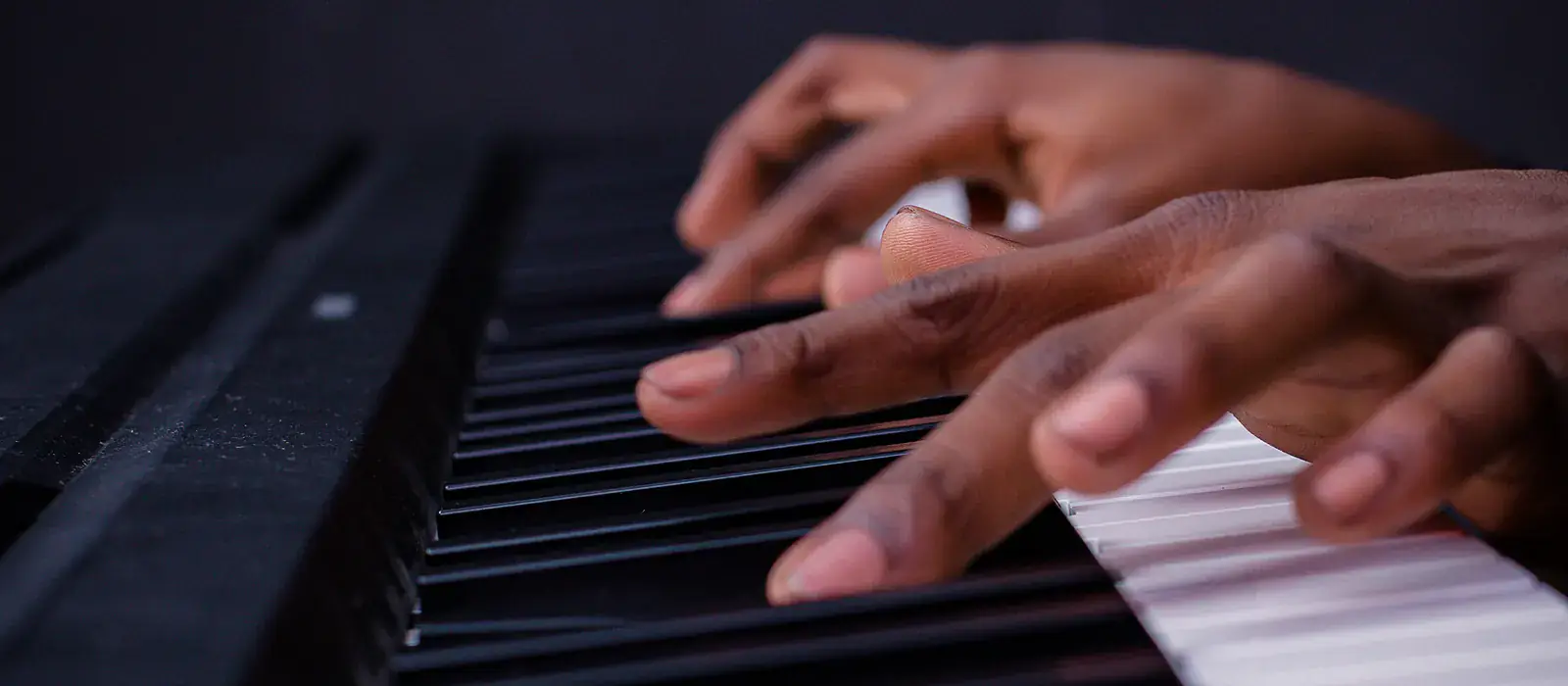
Press a key on a real piano. The sound responds to how hard you push — softly for soft, hard for loud. Press the same key gently and slowly and you can almost feel the hammer balance against the string before it falls. This is what musicians mean by "touch," and it is half of what makes piano playing expressive.
A keyboard with unweighted keys feels nothing like this. Press softly or hard — same volume, same character. After a year of practice on an unweighted keyboard, a student who sits down at an acoustic piano discovers they have built almost no touch control at all. Their fingers fly. Their dynamics are flat. They have to relearn how to play, and they're frustrated because they thought they were further along than they are.
This is the single biggest argument against starting on a cheap keyboard if you can afford otherwise. The skills don't fully transfer.
Where keyboards still make sense
They do, often. Three scenarios where we actively recommend starting with a keyboard:
- You're testing the waters. A six-year-old who has never played anything — you don't yet know if they'll stick. A KES 25,000 keyboard for the first 12 months is sensible. Upgrade later when commitment is clear.
- Space is genuinely tight. A digital piano needs a permanent home; a keyboard packs away. For a small Nairobi apartment, this is a real constraint, not an excuse.
- You're an adult learner, casually. If you want to play for fun, accompany yourself singing, work out chords from songs you like — a good keyboard is enough. The case above (touch, transfer, ABRSM exams) is mostly about classical pathway students.
The digital piano middle ground
If we could give one piece of buying advice, it's this: a weighted-key digital piano is the right choice for 80% of beginner households in Nairobi. It costs about twice what a keyboard does and roughly half what a used acoustic does. It needs no tuning. It can be turned down or used with headphones at 10 p.m. without disturbing the household. The keys feel close enough to an acoustic that everything a student learns transfers cleanly. And resale value, when families upgrade to an acoustic later, is reasonable on the major brands.
Look for: 88 weighted keys (not 61 or 76), at least three pedals or a sustain pedal connection, and a brand name your tuner will have heard of. Yamaha P-series, Casio PX series, Roland FP series are all sensible starting points. Avoid no-name digital pianos sold as "weighted" — many use a spring-loaded mechanism that mimics weight without simulating it.
When to consider an acoustic
Acoustic pianos reward serious students in a way nothing else does. The resonance through the room, the slight imperfections, the responsiveness to humidity and time — these are part of what makes piano music rather than sound. If you have:
- A child who has been studying for 2+ years and is committed,
- Space and a stable indoor environment (not direct sunlight, not next to a fan blowing on it),
- Budget for the instrument plus twice-yearly tuning (KES 5,000–8,000 per visit in Nairobi),
then an acoustic upright is the right next step. We are happy to refer parents to two or three tuners we trust in Nairobi to inspect a used piano before purchase. Don't buy an acoustic without that inspection — internal damage that costs KES 80,000 to repair is invisible from the outside.
What our students actually use
For honesty: at our Kikuyu studio we teach on acoustic uprights. About half of our current piano and keyboard students practise at home on digital pianos, a third on keyboards, and the remainder on acoustics. The students who progress fastest, all else equal, are not the ones with the most expensive instruments — they're the ones whose instrument fits their commitment level and is in a room where they actually sit down at it. A keyboard played daily beats an acoustic that lives in the formal living room nobody enters.
Specific models worth considering in Nairobi
If you're buying new, the brands we trust because we've watched them survive the Kenyan climate for years:
- KES 25,000–35,000 keyboard band: Casio CT-S series, Yamaha PSR-E series. 61 keys, light action, decent built-in sounds. Avoid no-name brands below KES 20,000 — they often have keys that stick and electronics that fail within 18 months.
- KES 50,000–80,000 digital piano band: Yamaha P-45, Casio Privia PX-S1100, Roland FP-10. 88 weighted keys, basic piano sounds, sustain pedal included. These are the workhorses of beginner piano households in Nairobi — we have students on each.
- KES 90,000–150,000 digital piano band: Yamaha P-125, Casio Privia PX-S3000, Roland FP-30X. Better speakers, more nuanced key action, more useful sound libraries for older students who want to explore beyond classical piano.
- KES 150,000+ used acoustic upright: Yamaha U1, Kawai K-series, Petrof, Schimmel. Bring a tuner you trust to the inspection. A KES 200,000 acoustic that needs KES 80,000 of internal work is a worse buy than a KES 120,000 instrument in good condition.
If you're buying used, the digital piano resale market in Nairobi is reasonable for the major brands — Yamaha and Casio hold their value, lesser brands depreciate hard. Facebook Marketplace and the OLX equivalent are where most private sales happen; if you're not comfortable evaluating an instrument yourself, ask your prospective music school whether they'd accompany you to look at a used unit. We've done this for families before; most reputable schools will.
The accessories nobody mentions
Budget for the following in addition to the instrument itself:
- Adjustable bench (KES 4,000–8,000). A dining chair is the wrong height for almost every child and most adults. Posture matters from lesson one.
- Headphones (KES 2,000–5,000). For digital instruments only. Sony, Audio-Technica, or Sennheiser entry-level models are all fine. Avoid Bluetooth — latency makes them unusable for music practice.
- Sustain pedal (KES 1,500–3,500). Often bundled with digital pianos, sometimes not. Check before purchase. A good pedal lasts years; the cheapest spring-loaded ones squeak within months.
- Music stand or stand-mounted holder (KES 1,000–3,000). The music has to sit at eye level. Don't read sheet music off your lap.
- Practice light (KES 2,000+). Kenyan evenings are dark by 7 p.m. A small clip-on or stand-mounted LED makes the difference between practice happening and not.
Total accessory budget: roughly KES 12,000–20,000 on top of the instrument. Worth planning for in the same conversation.
Upgrading later — and selling the old one
Most families upgrade once, around year two or three. The typical path is keyboard → digital piano, or digital piano → acoustic upright. We rarely see students upgrade from acoustic — they tend to stay on the instrument they chose at that level.
When you upgrade, the old instrument almost always has a market. Major-brand digital pianos in good condition sell within two weeks at roughly 50–60% of the original purchase price. Major-brand keyboards retain less value — closer to 30–40% — because new keyboard models keep improving and used-keyboard buyers are price-sensitive. Plan financially for the depreciation rather than expecting full resale recovery.
One word of caution on used acoustic uprights: they don't always sell. The Nairobi market for used acoustic pianos is thin, and a piano that needs significant repair work to be playable is sometimes given away rather than sold. If you buy an acoustic, buy with the assumption that you'll keep it for at least a decade.
The decision, simplified
If you're not sure yet — keyboard, KES 25,000, for the first year. If your child has been at it six months and the commitment is clearly there — digital piano with weighted keys, KES 60,000. If you're a year or two in and the pathway is serious — acoustic upright, with a tuner's inspection.
Whatever you decide, decide after a few lessons rather than before. Our first lesson is a free discovery session partly so families can make this decision with real information. We'll happily talk through your specific situation — the household, the child, the budget — and recommend the buy that makes sense for you. See our full pricing for ongoing sessions, or browse keyboard hire if you want to try before you buy.
Share this piece
WhatsAppContinue reading
More from Guides.
Guides
How to choose your child's first instrument — a Kenyan parent's guide
Piano, keyboard, guitar, violin or voice — the first instrument shapes years of practice habits. Here's how Kenyan parents we work with actually decide, and what we wish more of them knew before they bought anything.
Concerto Team · 9 min read
Guides
Ready for your ABRSM exam? How we check before you pay to sit it
ABRSM entry fees aren't small, and they climb with every grade. So before any Concerto student books an exam, we run an honest readiness check — a full mock under real conditions. If you're not ready, we say so. Here's exactly how we decide.
Concerto Team · 5 min read
Guides
The ABRSM exam pathway, explained for Kenyan students and parents
Grade 1 to grade 8, prep tests, theory exams, performance grades — what the ABRSM ladder actually looks like in Kenya, what each grade asks of a student, and how to use exams as motivation rather than pressure.
Concerto Team · 8 min read
Ready to try a lesson?
Free discovery session at our Kikuyu studio, in-home across Nairobi, or live online. We'll be honest about whether we're the right fit.