
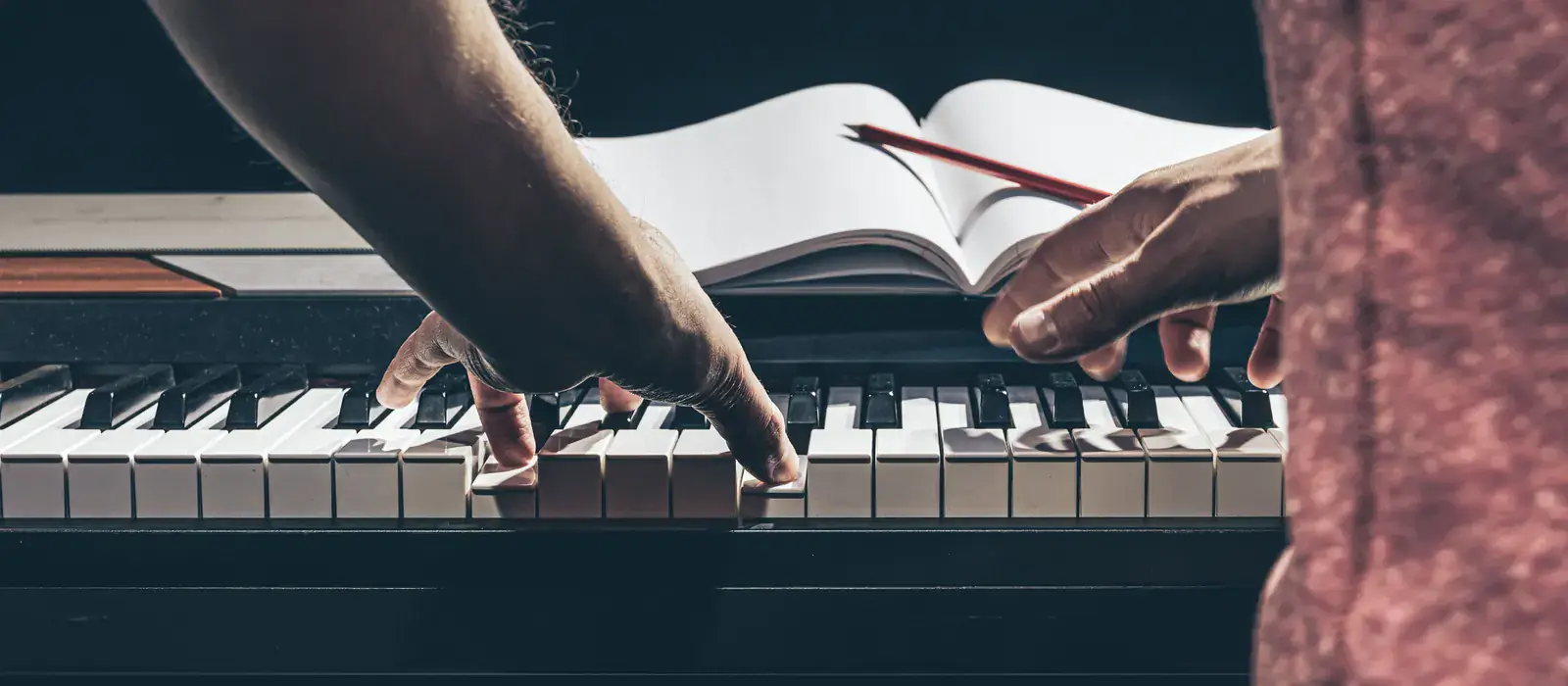
The first six months of piano lessons — what real progress looks like (and what doesn't)
Most parents quietly worry their child isn't progressing fast enough. After 10 years of teaching beginners, here's what genuine progress actually looks like in the first six months — and the four warning signs that something has gone off track.
 Concerto Team
- # piano
- # beginners
- # progress
- # parents
The conversation happens almost every week, usually in the corridor after a lesson. A parent leans in: "Is she on track? It feels slow." The answer is almost always yes, the progress is fine, but the parent has been benchmarking against the wrong things — usually a YouTube child prodigy, or a niece who started a year earlier. This guide is what we wish parents knew at month one: a realistic month-by-month picture of what a typical beginner achieves, and what to actually watch for.
Month 1 — finding the keys
The first month is overwhelmingly orientation. A six- or seven-year-old beginner is learning where Middle C is, how to find the black-key groups of two and three, what a quarter note is, and how to keep their right thumb on C while playing simple five-note tunes with the rest of the hand. They are not yet reading from staff notation.
By the end of month one, a typical beginner will play three or four short tunes — "Twinkle Twinkle", "Mary Had a Little Lamb", maybe "Au Clair de la Lune" — with the right hand only, by memory or by following finger numbers. The left hand is uninvolved. This is correct. Adding the left hand too early is the most common pedagogical mistake; we deliberately keep it out until the right hand is comfortable.
Month 2 — the staff appears
The treble clef shows up. Note names are introduced (C-D-E-F-G first, then up to G in both hands later). Reading is slow — a beginner reading a single bar of music takes a full minute or longer. This is normal. Reading is the slowest of all the music skills to develop; it requires connecting a symbol on paper to a finger on a key, and that neural pathway is genuinely new.
By end of month two, a typical student plays small pieces from notation (not memory) using fingers 1-5 of the right hand. They can name the lines and spaces of the treble clef. They are starting to count out loud as they play.
Month 3 — the left hand joins
Now both hands. The first attempts will look comical — left hand a fraction behind, brain visibly working, eyes darting between hands. This is the hardest month of beginner piano because suddenly the cognitive load doubles. A piece that took 30 seconds to learn last week now takes a week of practice.
This is where the first plateau hits. Many parents see their child suddenly "struggling" and wonder if the teacher is going too fast. They almost always aren't. Two-handed playing is genuinely a new skill, and the slowdown is a feature of building it, not a sign of failure.
Month 4 — fluency returns
The two-handed coordination clicks. Pieces that took a week now take two or three days. A typical student is reading both clefs, playing four-line pieces with hands together, and starting to handle simple rhythms beyond plain quarter notes. They might be starting to play their first piece in a key other than C major — a G or F major piece, with one sharp or flat.
This is where parents typically stop worrying. The visible progress is reassuring. Practice becomes easier to enforce because the child can hear themselves getting better.
Month 5 — pieces get longer
Eight-bar pieces become 16-bar pieces. Dynamics enter — playing softly versus loudly. Some technical exercises appear: scales, in tiny doses, usually just five notes of C major hands separately. The student is starting to "perform" pieces rather than just decode them — playing all the way through without stopping when they hit a wrong note.
This is also when most students could, if exam-bound, start preparing for ABRSM Prep Test or Initial Grade. We don't push exams in the first year — but the technical foundation for them is being laid here.
Month 6 — the first real piece
By month six, a typical beginner has a piece they're proud of — usually 16 to 24 bars, in C, G or F major, with both hands, with deliberate dynamics, that they can play start to finish at a recital. If you have a family gathering at Christmas or a school event, this is the piece your child plays. It's a real moment.
They will also have started understanding rhythm in their body — counting out loud, tapping their foot, occasionally playing along with a metronome for short stretches. They know maybe 15 to 20 musical terms (forte, piano, allegro, andante). They can write the names of notes on a staff. They are, by any reasonable definition, a beginner pianist rather than a child taking piano lessons.
Setting up the practice environment
The single most predictive factor in how much a child practises is how friction-free the practice is. Six things to set up properly in week one:
- Instrument always uncovered. A keyboard with a dust cover or fabric throw on top adds a small step that, multiplied across a year, costs you genuinely meaningful practice time.
- Music stand at the right height. Eye-level reading prevents neck strain and makes practice sustainable for longer.
- Bench, not a chair. Adjustable height matters more for children than adults. A bench that's too tall pushes the wrists into the wrong angle.
- Pencil within reach. Fingering numbers, dynamic markings, reminders from the lesson — they all get pencilled into the score. A child who has to walk somewhere to find a pencil doesn't make the annotations, and the lesson notes evaporate by the next week.
- Music folder organised. Current pieces in one section, finished pieces in another. The lesson teacher will help with this in the first few weeks; the parent maintains it after.
- Lighting that doesn't fade at 6 p.m. Practice often happens in early evening. Make sure the music is genuinely readable.
The parent's role in the first six months
The most common question we get from parents in the first month is: "Should I sit with them during practice?" The honest answer depends on the child's age and the household routine.
For children under 8, yes — but as a quiet presence rather than a coach. Sit with a book in the same room. Your job is to make practice feel companionable, not to correct what they're doing. Pointing out wrong notes during practice is one of the fastest ways to make a child resent the instrument. Save the corrections for the trainer.
For children 8 and over, increasingly no. By this age, daily practice should be moving toward independent — the child sits down at the instrument and works on what the trainer assigned. Parents who continue to supervise into this age range often find their teenager pushes back, sometimes by quitting entirely. The transition from supervised to independent practice happens somewhere between age 8 and 11, and parents who make it gracefully tend to have students who play longer.
What every parent can do at any age: listen to the music. Not the practice itself — the music. Play recordings of the pieces your child is learning, on speakers in the kitchen while you cook. Comment on what you noticed in their playing this week, specifically and kindly. The child who feels their parent is genuinely interested in what they're learning practises more readily than the child whose parent only asks "did you practise today?"
Celebrating progress without overpraising
A small thing that matters more than parents realise: how you respond when your child plays you a new piece. Two common mistakes — over-praising in a way that feels hollow ("That was AMAZING") and under-noticing in a way that feels dismissive ("Yes very good, are you ready for dinner?").
What works better: specific, sincere observation. "I noticed the soft part in the middle was really gentle this week — last time it was much louder." "The fingering in that fast bit must have been hard." "I could hear that you'd really worked on the ending." The specificity tells the child you actually listened, and that you understand effort separately from outcome.
The reverse is also true. Children who only play when they've prepared a polished performance miss the point of practice. Make it normal for your child to play through a piece they're still learning, mistakes and all. The willingness to be heard mid-process is part of what becoming a musician means.
The four warning signs
Not all slow progress is normal. Four signs that something has actually gone off track:
- Six months in and still no two-handed playing. If a student is in month six and still playing hands separately, something is wrong — either the pace is too slow, the home practice isn't happening, or the foundation is shaky.
- Six months in and pieces are still being memorised rather than read. Memorising tunes is fine in month one. By month six, reading should be primary. If your child plays only by memory, they haven't built reading.
- Practice has become tearful or avoidant. Lessons can be hard; daily practice should not be a battle. If it is, something needs to change — pace, format, teacher, or even the instrument choice.
- Lessons feel disconnected from each other. Each lesson should build on the last. If your child arrives each week to "something new" with no continuity, the structure has broken down.
Any of these, talk to your trainer directly. If the conversation doesn't resolve it, talk to the school. At Concerto we welcome these conversations — we have a direct line for parents who want to discuss progress without putting it in front of the child.
What progress is not
One last thing. Progress is not playing fast. It is not playing loud. It is not playing pieces above the level they're being taught. A six-year-old who hammers through "Für Elise" with wrong notes and no dynamics is not ahead of a six-year-old playing a 16-bar piece beautifully. We see this often — parents who proudly show us a video of their child playing a piece three grades above their level. In almost every case, the child has skipped the slow technical foundations that make the harder piece worth playing.
If you're six months in and your child can read music, play with both hands, count rhythm, and finish a piece they're proud of — they're exactly where they should be. Book the next lesson, keep going, and trust that the slow months are doing more than they look like they are.
Share this piece
WhatsAppContinue reading
More from Guides.
Guides
How to choose your child's first instrument — a Kenyan parent's guide
Piano, keyboard, guitar, violin or voice — the first instrument shapes years of practice habits. Here's how Kenyan parents we work with actually decide, and what we wish more of them knew before they bought anything.
Concerto Team · 9 min read
Guides
Ready for your ABRSM exam? How we check before you pay to sit it
ABRSM entry fees aren't small, and they climb with every grade. So before any Concerto student books an exam, we run an honest readiness check — a full mock under real conditions. If you're not ready, we say so. Here's exactly how we decide.
Concerto Team · 5 min read
Guides
Piano vs Keyboard for beginners — what to buy in Nairobi, and why it matters
They look similar, cost very different things, and produce wildly different learners. A practical guide to choosing — and what we actually tell parents who walk into our Kikuyu studio with this question.
Concerto Team · 8 min read
Ready to try a lesson?
Free discovery session at our Kikuyu studio, in-home across Nairobi, or live online. We'll be honest about whether we're the right fit.