Music for CBC — what Kenyan parents need to know about the curriculum
The Competency-Based Curriculum is reshaping how music is taught in Kenyan schools. Here's what's actually in the syllabus, how it differs from what most parents experienced, and how private music lessons fit alongside it.
 Concerto Team
- # cbc
- # curriculum
- # schools
- # parents
The Competency-Based Curriculum — CBC — has been reshaping Kenyan primary and junior secondary education since 2017. For music specifically, it represents a real change in philosophy: less rote learning of European classical theory, more emphasis on listening, performing, composing, and engaging with Kenyan musical traditions alongside global ones. For parents who grew up with the 8-4-4 system, the difference can be confusing. This guide walks through what's actually in the CBC music curriculum, what your child is expected to be able to do at each level, and how private music lessons fit alongside school music.
How CBC frames music
CBC organises every subject around competencies rather than content lists. For music, that means the syllabus is built around four core practical strands:
- Listening and responding — hearing music with intent, identifying instruments, rhythms, moods.
- Performing — singing, playing, moving to music, both solo and in groups.
- Composing — creating original short pieces, arranging, improvising.
- Music and culture — understanding music in its context, including specific Kenyan musical traditions.
If you went through 8-4-4, you'll notice immediately that "music theory" as a memorisation subject is not on this list. Theory is still taught — but it's framed as a tool for performing and composing, not as a standalone subject to be revised before an exam. This is a meaningful shift, and we think a positive one.
What's expected at each level
Lower primary (PP1 to Grade 3)
Music in lower primary is woven into Creative Arts, alongside art and movement. Children sing simple songs, clap rhythms, identify loud versus soft, fast versus slow, and recognise a small number of common instruments by sound. By Grade 3, they should be able to sing a Kenyan folk song from memory, keep a steady beat in a group, and use simple percussion (shakers, sticks, drums) to accompany singing.
Upper primary (Grades 4–6)
Music becomes a more distinct strand within Creative Arts. Notation is introduced (treble clef, basic note values), students start identifying notes on a staff, and the listening curriculum expands to include both Western classical samples and Kenyan musical traditions across communities. Composing tasks appear — creating a four-bar rhythm, arranging a known song with simple percussion accompaniment.
Junior secondary (Grades 7–9)
Music can be chosen as an optional subject in junior secondary, depending on what the school offers. For students who take it, the level steps up significantly: more complex notation, song-writing tasks, ensemble work (school choir or instrumental group), and history of music units that cover both Kenyan music and broader world traditions. This is also where the gap between school music and private music lessons becomes most visible.
Senior school (Grades 10–12)
Senior school music, where offered, is taught at a level comparable to the old KCSE music subject — students learn harmony, can compose four-part works, study set repertoire in depth, and prepare for performance assessment. Students aiming for university music programmes use senior school music alongside the ABRSM exam ladder to build a credible portfolio.
The strength — and the gap
The CBC framework is strong on the broad musical literacy a citizen should have — listening, cultural awareness, basic performance, the ability to sing a song and clap a rhythm. It is genuinely better than 8-4-4 at building students who enjoy music rather than just remembering facts about it.
Where it has gaps, in our experience teaching alongside it: technical instrumental skill, deep theory, and exam-pathway preparation. School music is broad but rarely deep. A student aiming at Grade 5 ABRSM by age 13 will need private instruction to get there — the CBC curriculum doesn't pretend otherwise, and good schools refer parents to private teachers when a child shows serious aptitude.
Where private lessons fit alongside school music
Three common patterns we see:
- Reinforcement. The child loves school music and wants more — private lessons add depth on a specific instrument they enjoyed in class. This is the most common starting point.
- Bridging to ABRSM. The school music programme has done its job, the child is musically curious, and the family wants the structure of the international exam ladder. Private lessons run alongside school music through primary and junior secondary, then often replace it as a serious commitment in senior school.
- Filling the gap. The child's school doesn't offer strong music provision past lower primary, and the family wants their child to have it anyway. Private lessons become the main musical education.
All three are valid. None of them puts private and school music in competition — they complement each other.
How to support a CBC music learner at home
Three practical suggestions, in order of impact:
- Listen with them. CBC asks students to listen actively. Play a variety of music in the car or at home — Kenyan benga, classical, jazz, choral. Ask what they hear. The conversation matters more than the conclusion.
- Sing together. The performance strand benefits enormously from a household where singing is normal. It doesn't matter that you can't sing — it matters that your child sees you trying.
- Take the instrument seriously if there is one. If your child has started keyboard, recorder, or guitar at school, the difference between five minutes of practice a day and zero is everything. The school does the introducing; the home does the consolidating.
What a strong school music programme looks like
If you're choosing between schools for your child, or evaluating whether your current school is doing music well, four markers separate the strong programmes from the weak:
- A dedicated music teacher, not a class teacher who happens to teach music. Music is a specialist subject. Schools that rotate music through whoever has a free period rarely produce strong musical learners.
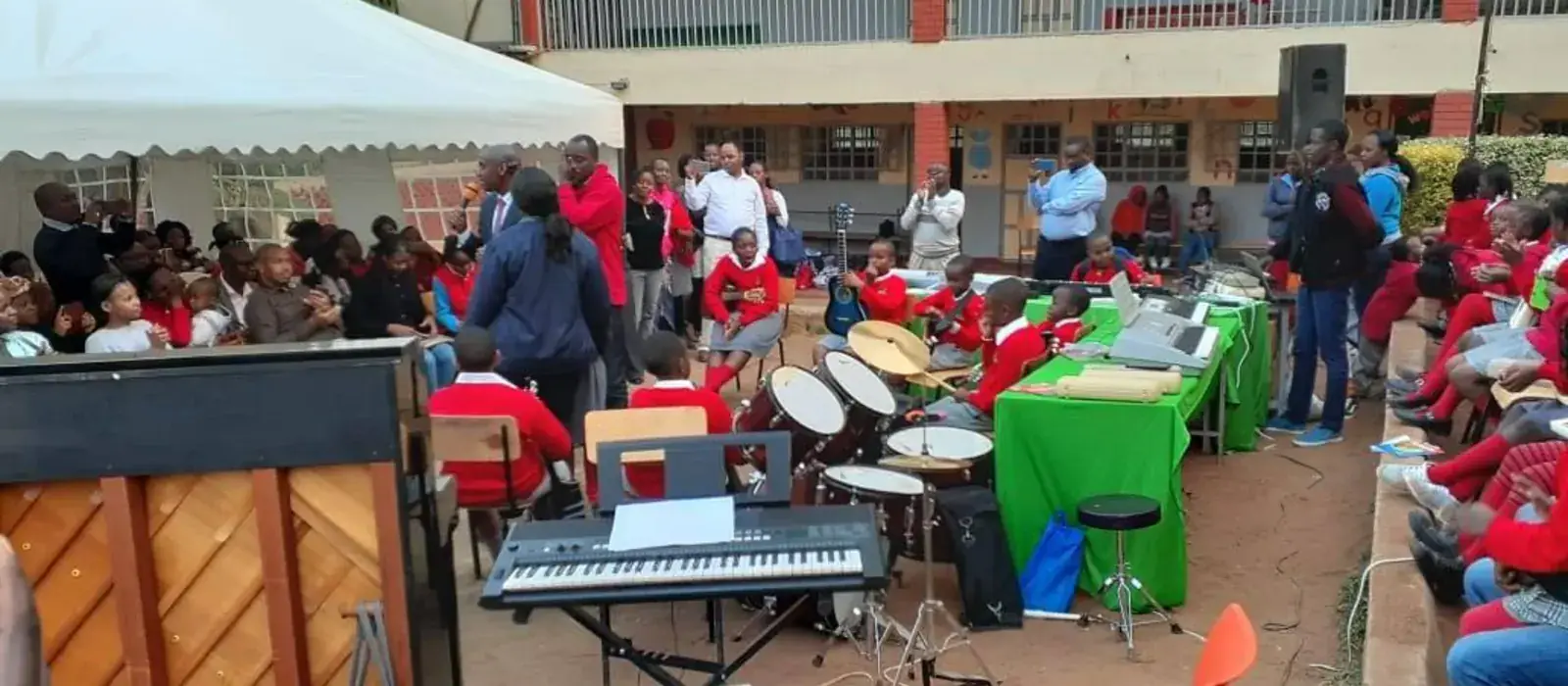
- Instruments available for students to use. Even a small budget for class keyboards, percussion, and a couple of guitars makes an enormous difference. Strong programmes have an instrument cupboard; weak ones have a piano nobody is allowed to touch.
- Regular performance opportunities. Whole-school assemblies, parents'-day concerts, KMF entries. The schools whose students develop best are the ones where children perform regularly in front of audiences — not professionally, just often.
- External examiners visit the school. Schools that bring in ABRSM examiners (or partner with a music school that hosts them) signal that they take the exam pathway seriously and prepare students accordingly.
If your child's school has none of these, school music will not carry them very far on its own — private lessons will need to do most of the work. If the school has all four, school music will give your child a strong foundation that private lessons can extend.
Public versus private school music under CBC
The honest assessment we'll share when asked: CBC has been more thoroughly implemented in well-resourced private schools than in most public schools. The curriculum framework is the same; the delivery isn't. Public school music in 2026 is, in most parts of the country, still constrained by class size, instrument shortages, and music teachers with broad rather than deep training.
This isn't a criticism of public school teachers — many of whom are genuinely excellent within the resources they have. It's simply an honest observation parents should plan around. If your child attends a public school and shows real musical aptitude, private lessons will need to do most of the heavy lifting. If your child attends a well-resourced private school with a strong music department, school music will carry more of the work, and private lessons supplement rather than substitute.
One pattern we see often: students at strong-music schools who take private lessons in addition develop further and faster than either group on its own. School music gives ensemble experience, performance opportunities, and broad musical literacy. Private lessons give technical depth on the specific instrument and exam-pathway focus. The combination is more than the sum of its parts.
The transition into senior school music
For students who want music to continue into senior school (Grades 10–12), the CBC framework allows music as an optional subject, but its availability depends entirely on the school — schools have to actively choose to offer it.
Three things to look for when choosing a senior school if music matters to your family: (1) the subject is actually offered, not just listed as available; (2) a dedicated music teacher with conservatoire or university-music training; (3) the school has at least a few students each year taking music seriously enough to support a class-cohort rather than a one-on-one tutorial.
For students going abroad to university with music ambitions, the combination of senior school music alongside Grade 8 ABRSM (and ideally a diploma) opens doors that either credential alone does not. Plan the pathway back from the goal — if your child wants to study music at university, the work begins in junior secondary, not in the final year of senior school.
For schools and parents working together
We run an in-school music programme for Nairobi and Kiambu schools whose own music provision needs supplementing — Concerto trainers visit on a fixed schedule and teach group or individual sessions on-site. We also run CBC-aligned music coaching for upper primary students preparing performance assessments. If your child's school is interested in either, we're happy to talk to the head of music directly.
For families considering private lessons alongside school music, the first session is a free discovery session and designed as a discovery — for you, your child, and us — to decide together whether weekly private lessons are the right next step. See pricing for ongoing sessions, or read our guide to choosing a first instrument if you haven't already.
Share this piece
WhatsAppContinue reading
More from Guides.
Guides
How to choose your child's first instrument — a Kenyan parent's guide
Piano, keyboard, guitar, violin or voice — the first instrument shapes years of practice habits. Here's how Kenyan parents we work with actually decide, and what we wish more of them knew before they bought anything.
Concerto Team · 9 min read
Guides
Ready for your ABRSM exam? How we check before you pay to sit it
ABRSM entry fees aren't small, and they climb with every grade. So before any Concerto student books an exam, we run an honest readiness check — a full mock under real conditions. If you're not ready, we say so. Here's exactly how we decide.
Concerto Team · 5 min read
Guides
Piano vs Keyboard for beginners — what to buy in Nairobi, and why it matters
They look similar, cost very different things, and produce wildly different learners. A practical guide to choosing — and what we actually tell parents who walk into our Kikuyu studio with this question.
Concerto Team · 8 min read
Ready to try a lesson?
Free discovery session at our Kikuyu studio, in-home across Nairobi, or live online. We'll be honest about whether we're the right fit.