01
Studio.
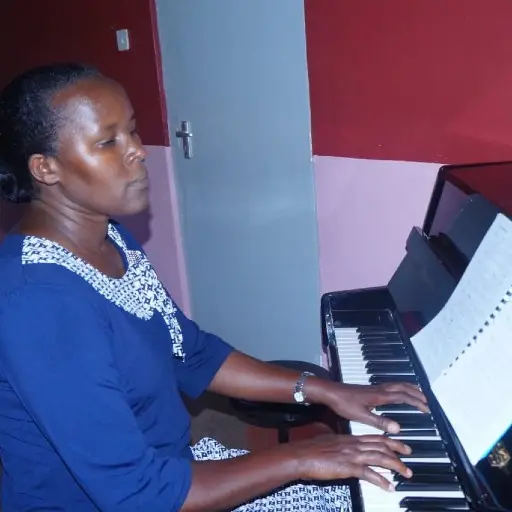
Come to our Kikuyu studio. Private or small-group sessions, in the room with your trainer and a proper instrument.
KES 1,600/ session
Book a studio classFlute lessons
The flute makes its sound from breath alone — no reed, just the air you shape across the embouchure hole. We build that tone from your first lesson: posture, hand balance across the three joints, a steady column of air, and the articulation that turns notes into music. ABRSM grades 1–8, beginners to diploma, in Kikuyu, Nairobi or live online.
Accreditation
ABRSM Flute syllabus
Grade range
Initial – Grade 8 + diploma
Start age
From 8 (front teeth in, arms long enough)
Formats
Private · Group · Family · Online
The journey
Beginner to Grade 8 (ABRSM). Each milestone below is roughly a year of consistent practice; ABRSM certification is recognised worldwide and counts toward UCAS points for university applications.
01
Foundation (Pre-Grade 1).
Making a clear sound on the head joint alone, then assembling the full flute without bending the keys. Hand balance (the flute rests on three points, not gripped), the first octave of notes, and reading the treble staff. Long tones to settle the air.
Outcome:A reliable tone across the first octave — ready for ABRSM Initial or Grade 1.
02
Grade 1 – 2.
The full low-to-middle register, the first scales (G, F and D majors with their arpeggios), tongued vs slurred articulation, and three short repertoire pieces. Steady breathing plan marked into the music.
Outcome:ABRSM Grade 2 — first-octave confident, reading at sight, ensemble-ready.
03
Grade 3 – 4.
Into the second octave and the trickier crossing-the-break notes, faster scales and chromatic passages, dynamic control on a sustained line, and expressive phrasing. First taste of vibrato as a colour, used deliberately rather than constantly.
Outcome:ABRSM Grade 4 — two octaves secure, performing solo and in ensemble.
04
Grade 5 – 6.
Theory Grade 5 (the ABRSM gateway to higher practical grades), the full three-octave range including the bright top register, double-tonguing for fast passages, controlled vibrato, and Baroque and Classical sonata movements.
Outcome:Theory Grade 5 passed — unlocks Grades 6–8.
05
Grade 7 – 8.
Performance-level interpretation across the full range, advanced techniques (flutter-tonguing, harmonics, fast double- and triple-tonguing), concerto and recital repertoire, and an introduction to the piccolo for those who want to double.
Outcome:ABRSM Grade 8 — a diploma-entry credential recognised worldwide.
06
Diploma & beyond.
ARSM, DipABRSM and LRSM preparation. For students targeting orchestral or band seats, undergraduate music study, teaching, or professional session work. Piccolo and alto-flute doubling developed here.
Outcome:Diploma certification — eligible to teach and perform flute professionally.
How you can learn
01
Come to our Kikuyu studio. Private or small-group sessions, in the room with your trainer and a proper instrument.
KES 1,600/ session
Book a studio class02
Trainer comes to you — Muthaiga, Kileleshwa, Kilimani, Upperhill, Milimani. Same faculty, your space, no commute.
Premium · pricing on enquiry
How in-home works03
Live one-on-one over our private classroom. Anywhere with a stable connection — Kenya or abroad.
KES 2,000/ session
Try onlineInside the room
Every session has a rhythm. Here's the shape of a typical hour — adjusted up or down depending on age, grade and what your last week looked like.
00:00 – 00:08
Long tones & warm-up.
Slow long tones from middle to low register, listening for an even, focused sound as the note descends. Tune to a piano A and check the head-joint position.
00:08 – 00:18
Technique focus.
Scale of the week (currently D major, two octaves) and its arpeggio, then a tonguing drill alternating single-tongued and slurred groups across the break.
00:18 – 00:38
Repertoire.
One ABRSM piece worked in detail — breath plan marked in, phrasing shaped, the awkward third-octave entries practised slowly then brought up to tempo.
00:38 – 00:52
Sight-reading & ear.
A fresh short piece read cold with the breaths planned first, then aural tests — pitch matching and clapping back simple rhythms.
00:52 – 01:00
Practice plan.
Daily targets in the student journal — long tones first, scales second, the tricky bars of the repertoire third.
Frequently asked
Usually from age eight. Two things have to be in place: the adult front teeth (the embouchure forms against them) and arms long enough to reach the keys comfortably with the head turned. Younger keen children can begin on the recorder or a curved-head "student" flute, which shortens the reach, then move across.
It is one of the best. There is no reed to fuss with, it is light and portable, the fingering is logical, and a clear note is achievable in the first few lessons — which keeps beginners motivated. The one early hurdle is simply getting a sound across the embouchure hole; most students manage it within a lesson or two.
A reliable student flute (for example a Yamaha YFL-212 or equivalent) runs roughly KES 18,000–35,000. Avoid the very cheapest unbranded flutes — the pads leak and the keys bend, which makes a good tone almost impossible and frustrates beginners. We can advise on what to buy and rent some instruments to get you started.
Start on a closed-hole (plateau) flute. Open holes are only needed for advanced techniques from around Grade 6, and most have a plug kit so you can convert later. For a beginner, closed holes remove one variable and let you focus on tone and fingering.
Yes — flute translates well to online lessons. A basic USB condenser microphone helps the trainer hear your tone, articulation and intonation clearly, and we teach in a low-latency private classroom. Many of our diaspora students learn entirely online.
Absolutely, and adults often progress quickly because they practise with focus. Expect the first few weeks to feel breathy while the embouchure muscles develop — that is normal and passes. Adult beginners are welcome at any age.
Yes. Our wind ensemble rehearses monthly at the Kikuyu studio and welcomes Grade 2 and above, and we programme a public end-of-year concert. Playing with others is where intonation and timing really sharpen.
Yes — families enrolling two or more children receive a multi-child discount automatically applied to the second child onward. Speak to our admin for current rates.
Book your first lesson — your trainer will meet you wherever you are, with a plan tailored to your goals.